
Growth Orbit helps companies improve CRM data quality for AI by validating the records agents will read. Most CRMs aren't ready for AI, because an AI agent reads the record exactly as it is. When Growth Orbit matched the Salesforce of one of our clients, a global services company, against Dun & Bradstreet company data, 70% of its more than 113,000 account records couldn't be tied to any company we could identify. The market it actually sells to is about 8,500 companies. Every answer an AI gives that company's leadership will come from those records.
The fix isn't a better model. It's governed data: a clean list of the companies you sell to, every record you can validate tied to one of them, and controls that keep it that way.
Why do AI agents fail on CRM data?
Growth Orbit starts with CRM data quality because AI agents read records built for people who could fill in the gaps. Those records were never built to be read by a machine.
The model usually gets the blame. Teams swap prompts, change settings and try another vendor, and the answers stay wrong. Gartner draws the line plainly: it predicts that through 2026, organizations will abandon 60% of AI projects unsupported by AI-ready data, and 63% of organizations either don't have, or aren't sure they have, the right data management practices for AI.
The problem is upstream of the AI. It's what your team typed.
What does an AI agent actually read in a typical CRM?
Growth Orbit assesses what an AI agent will read as true in your CRM: the duplicates, the accounts that match no real company, the blank fields and the close dates nobody believes.
Here's what that looked like at the global services company:
| What we measured | What we found |
|---|---|
| Account records in Salesforce | More than 113,000 |
| Companies in the market it sells to | About 8,500 |
| Records we couldn't tie to a company we could identify | 70% |
| Records with a website at all | About 25% |
| Extra records for companies already in the system (duplicates or unlinked parts of the same corporate family) | More than 13,000 |
The takeaway: an AI reading this CRM would be reasoning about more than thirteen times as many "accounts" as the company has real prospects, most of which we couldn't tie to a real company.
This isn't unusual. In a 2025 survey of 602 CRM users by Validity, which sells data-quality software, 76% said less than half of their organization's CRM data is accurate and complete.
How did CRM data get this bad?
Growth Orbit sees CRM data break down when the people being measured type what they're paid, measured or protected for typing.
We see the same pattern at client after client. Reps do the minimum the system demands. They use the CRM mostly to enter opportunities. A lot of them don't record what they know, because the CRM is visible to their managers and they don't want to show their hand. When a lead-generation program creates an opportunity, an account rep sometimes re-creates it as their own to get the credit, duplicating contacts on the way in.
It's not only incentives. In the same Validity survey, 37% of respondents said staff at their companies fabricate data "to tell the story they think decision-makers want to hear."
Why can't AI agents work around bad data the way people do?
Growth Orbit treats missing or unreliable CRM data as a verification problem because AI agents can't tell which gaps matter the way a person can.
A sales manager who sees a blank field asks the rep. A leader who sees a close date pushed again and again knows it's a placeholder. An agent does neither. It reads what's there and acts on it, and where nothing is there, it infers. As Hillary Remy put it in Inc., "the gaps that humans compensated for without thinking become the exact places agents fail."
Inference is where confident wrong answers come from. They're well written, they cite numbers, and they rest on records nobody can stand behind.
What happens when AI agents start writing to the CRM?
Growth Orbit recommends one audit trail for every CRM write because changes from several AI tools can make records harder to trust. Changes arrive from several tools at once, and usually nobody logs them in one place.
LeanData's 2026 survey of 157 of its own customers shows how fast this has happened. 93% had deployed at least one AI agent. Nearly one in three couldn't say how many agents were acting on their records. 30% had found actions on records with no audit trail, and 27% had seen more than one tool or agent contact the same prospect.
Gartner predicts AI agents will outnumber sellers ten to one by 2028. Its analyst Dan Gottlieb put the risk in one sentence: "If those systems are fragmented, the agents will scale the fragmentation."
How do you make CRM data ready for AI?
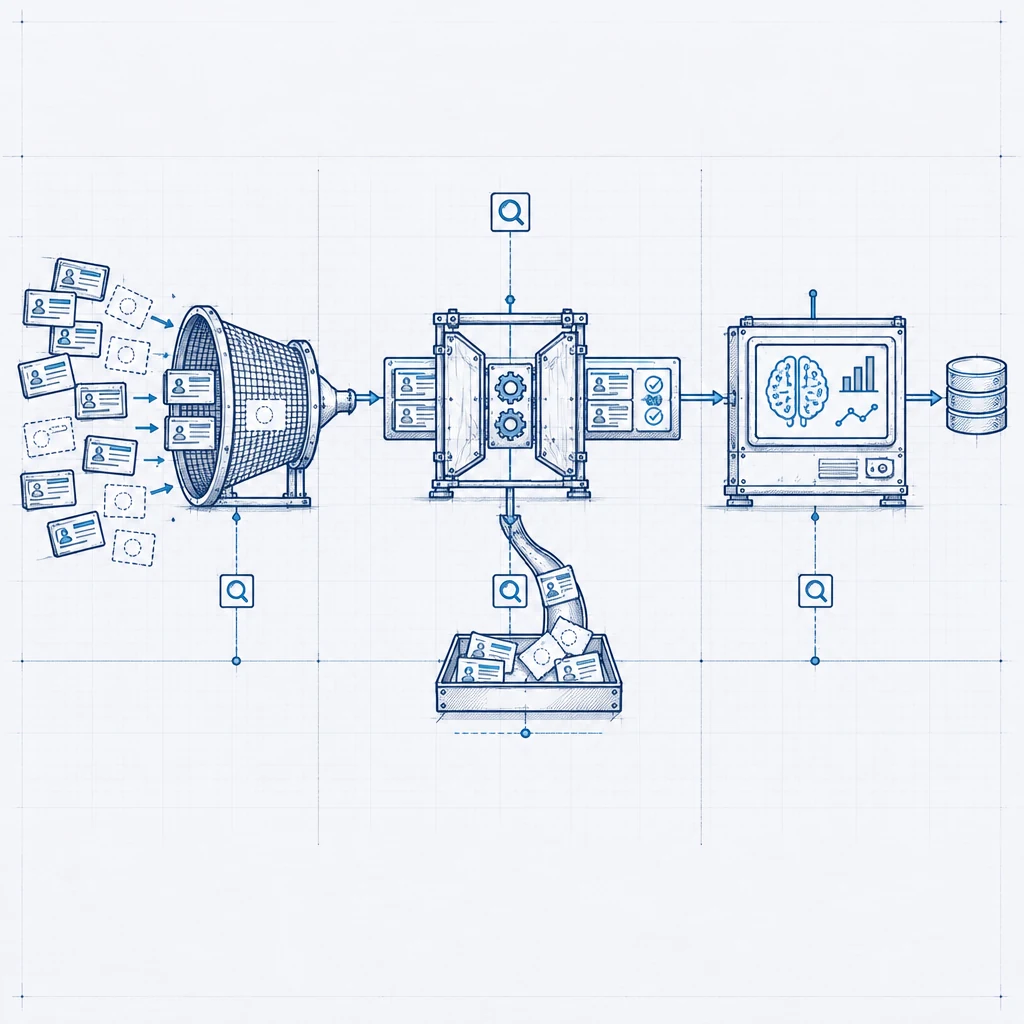
Growth Orbit makes CRM data ready for AI in a fixed order: market first, then the data, then the controls, and only then the AI. Most teams start with definitions or a new tool. That's the wrong place to start, because you can't define what to count until you know what you have.
- Build a clean TAM. List every company that fits your offer, from a company database rather than your CRM, counted once at the parent level with a standard company identifier.
- Assess your data against it. Match your CRM accounts to the TAM by identifier. Records that match are records you can validate. Records that don't are the ones to question or exclude.
- Put controls in the CRM. Every account carries an identifier or website domain. Every contact links to an account. Duplicate rules stop a second copy of a company. Every opportunity has one owner and a recorded source.
- Capture instead of typing. Log calls, emails and meetings automatically, and ask reps only for the judgment only they have.
- Name a data owner who understands both data and selling. Most sales teams don't have data people, and most data people don't work on the CRM.
- Let AI clean, under written rules. AI proposes matches, merges and missing fields. A person approves the ambiguous ones. Nothing gets overwritten without approval.
- Log every write. One record of every change, by a person, a rule or an agent from any vendor.
- Then point AI at your questions, and require every answer to cite the records behind it.
How can you tell if your CRM is ready for AI?
Growth Orbit recommends five CRM data readiness checks you can run this week, before any AI project starts.

| Test | What to check |
|---|---|
| Match rate | What share of your accounts tie to a real company you can validate? |
| Duplicates | How many companies appear more than once, and how many times? |
| Completeness | In ten random open deals, how many fields are empty or "TBD"? |
| Close dates | How many open deals have had their close date moved more than twice? |
| Citations | Can your AI tool show the records behind its answer? |
The takeaway: if you can't answer the first test, you don't know what your AI is reading.
Will CRM data ever be perfect?
Growth Orbit does not promise perfect CRM data because companies merge, people change jobs, reps keep typing and every new tool adds records of its own.
You can get it a lot better, and you can know exactly how good it is. Starting from a clean TAM means a large share of your records are validated the moment you match them, and the rest show up as exceptions instead of hiding in the averages. The goal isn't perfect data. It's knowing which numbers you can stand behind, and making that share bigger every quarter.
What else should you know about CRM data quality for AI?
Growth Orbit's approach to CRM data quality for AI starts with the market, validates the records and puts controls ahead of tools. These questions explain what that means in practice.
What is AI-ready CRM data?
Growth Orbit defines AI-ready CRM data as records an AI agent can act on without guessing: every account tied to a real company you can validate, every contact linked to the right account, duplicates controlled, activity captured as it happens, and every change logged. It starts with a clean list of the companies you actually sell to.
Will an "AI-powered" CRM clean up our data on its own?
Growth Orbit does not rely on an "AI-powered" CRM to clean records on its own: an AI tool won't know what a good record is unless someone defines it, and it can't tell a real duplicate from a legitimate subsidiary without rules. AI is a strong cleanup tool in the hands of people who understand both data and selling. On its own, it repeats what it finds.
Where should we start?
Growth Orbit starts with the market, not the CRM: build a clean list of the companies that fit your offer, then match your CRM against it. That one step tells you how much of your data you can trust, how much of your market you're missing, and what to exclude from your reports.
Steve Schilling is the founder of Growth Orbit. This post is adapted from his forthcoming book, Effort Is Not Evidence. For more on why the source of your data matters, read Buyer Intent Data vs. Usable Insight.